How to Draw Anime Hands Step by Step

Hands are the part of the figure most artists quietly avoid. A sleeve gets conveniently long. A character's arm disappears behind their back. The composition just happens to cut off at the wrist.
It's not laziness, it's the entirely rational response to hands being genuinely difficult. They're complex, they move in hundreds of configurations, and small proportion errors read immediately as wrong to any viewer because we spend our whole lives looking at hands.

The good news is that anime hands are a simplified version of real hands, and that simplification makes them learnable with a clear system. This guide covers that system from the ground up, construction, proportion, the most common poses, and how to build a reference workflow in Procreate that makes hands faster every time you draw them.
Why anime hands feel harder than they are?
The difficulty with hands isn't the hand itself, it's the number of variables. A hand has 27 bones, moves in three dimensions, and changes shape completely depending on what it's doing. A fist looks nothing like an open palm. A hand holding a pen looks nothing like a hand pointing.
Anime style reduces this complexity significantly. Fingers are simplified into smooth cylinders. Knuckle detail is minimal. The palm is a clean geometric shape. Nails are suggested rather than anatomically detailed.
What remains after simplification is proportion and structure and those can be learned systematically.
The block method :
How to construct any hand
The most reliable way to draw any hand, in any pose, is to start with two shapes: a block for the palm and cylinders for the fingers.

Step 1 — Draw the palm block
The palm is roughly square in anime style, slightly wider than it is tall for a relaxed hand, slightly taller than it is wide for a clenched or gripping hand. Draw it as a simple flat rectangle or trapezoid, wider at the knuckle line and slightly narrower at the wrist.
The palm is thicker than most beginners expect. When seen from the side, it has real depth, about half the width of the palm when viewed from the front. Keep this in mind for any hand pose that isn't directly front-facing.

Step 2 — Set the knuckle arc
Across the top of the palm block, draw a gentle arc. This is the knuckle line. The middle finger knuckle sits highest, the index and ring fingers slightly lower, and the pinky knuckle lowest. This arc is subtle but critical — a straight knuckle line produces a flat, unnatural-looking hand.

Step 3 — Add finger cylinders
Each finger is three cylinder segments — proximal (nearest the palm), middle, and distal (the fingertip). In anime style, these cylinders are smooth and slightly tapered toward the tip.
Finger length ratios (approximate):
Middle finger: longest — roughly equal to the palm height
Index and ring finger: slightly shorter, roughly equal to each other
Pinky: noticeably shorter, reaching roughly to the middle joint of the ring finger
Thumb: attaches lower on the palm, shorter overall, with only two segments
A common mistake is drawing all four fingers the same length. The variation in finger length is what makes a hand read as natural rather than geometric.
Step 4 — Add the thumb
The thumb is the most anatomically different finger and deserves its own attention. It attaches at the lower side of the palm — not at the knuckle line like the other fingers — and has only two segments rather than three.
The thumb's range of motion is much wider than the other fingers. In a relaxed hand it sits away from the palm at a natural angle. In a fist it tucks across the front of the folded fingers.
In anime style, the thumb joint (the large rounded mass at the base of the thumb) is often visible and gives the palm a slightly rounder shape on that side. Include it as a soft oval shape attached to the lower palm.
Proportion — how big should hands be?
Hands are almost always drawn too small. This is one of the most universal errors in figure drawing, and it makes figures look childlike or weak in ways that are hard to identify without measuring.
A useful check: a hand held flat against the face should roughly cover it from chin to hairline. This feels too large when you first apply it, but it's correct.
On a standing figure, the hand hangs to approximately mid-thigh. The hand itself is roughly the same height as the face, from chin to the top of the forehead.
In Procreate, if you're unsure about hand size, place a rough oval the size of your character's face next to the hand you've drawn. If the hand is noticeably smaller, scale it up before adding any detail.
Five essential hand poses for anime and manga
These five poses cover the majority of hand positions you'll draw across any character illustration or comic.

1 — Relaxed hanging hand
The default pose when a character is standing neutrally. Fingers are slightly curled — not straight, not fully bent. The hand faces inward toward the thigh. The thumb sits away from the palm.
Common mistake: drawing relaxed fingers perfectly straight. Real relaxed fingers always have a slight natural curl. In anime this is exaggerated slightly for expressiveness.
2 — Open flat palm (facing viewer)
Used for gesturing, stopping, or reaching. The key here is the knuckle arc — visible from this angle, it gives the hand depth. Fingers spread slightly, widest at the base of the fingers and tapering to the tips.
The thumb extends out to the side and slightly forward. If the thumb is parallel to the fingers rather than angled outward, the hand will look flat and wrong.
3 — Pointing finger
One of the most common poses in manga — a character directing attention, making a declaration, or targeting something. The index finger extends fully. The other three fingers curl into the palm. The thumb may be up (classic pointing gesture) or tucked.
The most common mistake here is the curled fingers — they should wrap around the palm in a loose fist, not just bend slightly. Draw them using the same cylinder method, just foreshortened.
4 — Gripping / holding an object
Hands gripping a sword hilt, a pen, a phone, or a cup follow the same principle: the object determines the finger shape. Fingers wrap around the object's cross-section. The thumb wraps from the opposite side, often overlapping the index finger.
Draw the object first, then wrap the hand around it. This sounds obvious but most errors in gripping hands come from drawing the hand first and trying to fit the object in afterward.
This is also where angle and foreshortening matter most. A hand gripping a sword held vertically looks very different from the same hand gripping a sword pointed toward the viewer. If you're unsure how the hand should look at a specific angle, a reference is not optional — it's the right tool for the job.
5 — Fist
The full fist is the most structurally complex common pose. Fingers fold in three stages: first at the knuckle, then at the middle joint, then at the fingertip, creating a layered stack when viewed from the front.
Key details in anime fist:
The knuckle line is prominent and reads as a row of rounded forms
The thumb tucks across the front, between the first and second knuckle lines
The side of the hand (the pinky side) is relatively flat
From the front, the fist is roughly square — close to the palm proportions
The fist is one of the most-used poses in action manga and one of the most referenced poses in stamp packs for exactly this reason.

Foreshortening :
Hands coming toward the viewer
Foreshortened hands (pointing directly at the viewer, reaching forward, or in a punching pose) are where many artists stop and redraw the scene to avoid the difficulty.
The key to foreshortening hands is the same as foreshortening any form: think in overlapping shapes rather than outlines. When a fist punches toward you, you see the knuckle faces as rounded rectangles, stacked and slightly overlapping. The fingers are almost invisible. The thumb is visible on one side. The wrist disappears behind the fist.
Draw what you actually see, not what you know is there. This is where construction from reference becomes almost mandatory for anything beyond simple poses.

Hands and character expression
In manga and webtoon storytelling, hands carry an enormous amount of emotional information. Closed tight fists signal tension, anger, determination. Open reaching hands signal vulnerability or longing. Hands hiding in sleeves or behind a back signal nervousness or concealment. A single pointing finger in a panel can carry as much visual weight as a character's face.
This is why getting hands right matters beyond technical accuracy. A hand drawn with the wrong tension — open when it should be clenched, limp when it should be gripping — creates a disconnect between what the face is saying and what the body language is saying.
When planning a character pose, decide what the hands are doing and what they're expressing before you start constructing them. The pose follows naturally.
Building a hand reference workflow in Procreate
The single biggest improvement most artists make to their hand drawing isn't more practice from imagination ,it's building a better reference system.
The problem with photo reference for anime hands
Photo reference is useful for understanding structure, but photographs of real hands don't directly translate to anime style. The proportions are different, the simplification level is different, and the angle-to-construction relationship doesn't map cleanly. You end up halfway between realism and stylisation, which tends to look worse than either.
Anime-native hand stamps as working reference
Hand stamp packs built specifically for Procreate solve this problem directly. The references are already in the correct anime proportion and simplification level. You place the stamp, scale it to your character, and draw over it or use it as a visual anchor on a reference layer.
The practical difference is significant. Instead of searching for a photo of a hand at the right angle, converting it mentally to anime style, and then drawing it, you place a reference that's already in the style you're working in and focus entirely on integration with the character.
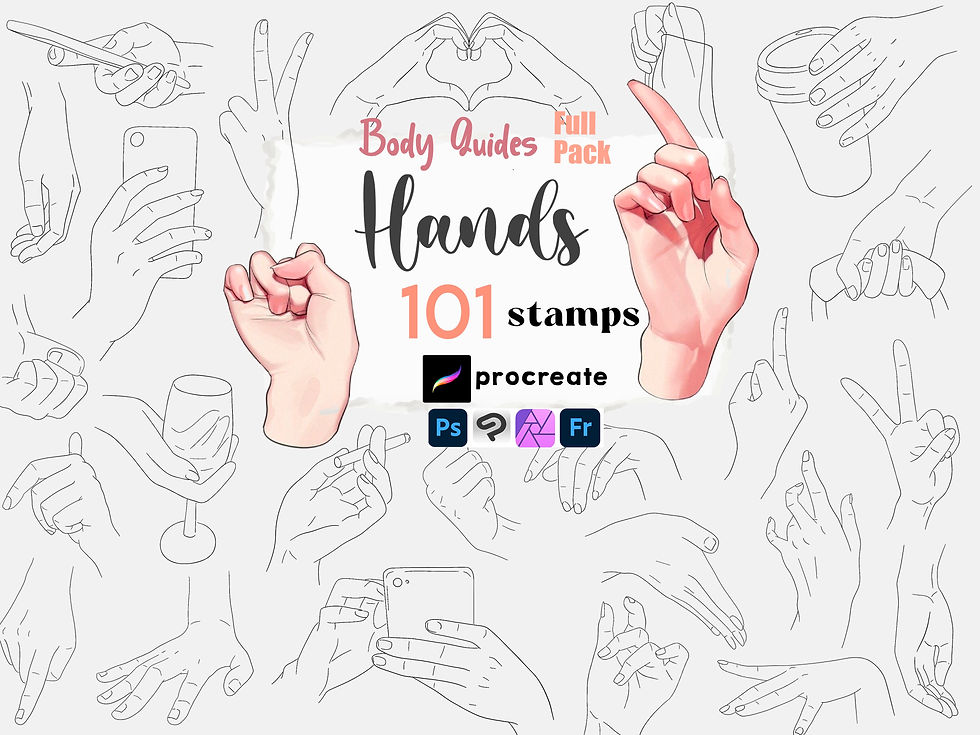
101 anime hand poses — built for Procreate The Hand Stamp Pack includes 101 Procreate-native hand stamps across a full range of angles and actions : open palms, pointing fingers, fists, gripping poses, peace signs, reaching hands, pen-holding hands, and more. Every stamp is drawn in anime style at correct proportions, ready to place on a reference layer and draw over. Designed for character artists who draw hands daily and want a reference that keeps up with production pace. [View on Etsy ↗] [Get on Gumroad ↗]
Building a personal hand reference sheet in Procreate
Even without a stamp pack, building your own reference sheet is worth the one-time investment. Spend a session drawing the five essential poses above from multiple angles — front, side, three-quarter, foreshortened. Save them as a Procreate file. Every time you get stuck on a hand pose, open this file on a second Split View window rather than starting from imagination.
Common mistakes :
Quick reference

Mistake | What it looks like | Fix |
Fingers all the same length | Robotic, unnatural hand | Middle finger longest, pinky noticeably shorter |
Hand too small | Character looks weak or young | Hand should roughly cover the face chin-to-hairline |
Straight relaxed fingers | Stiff, tense-looking neutral pose | Add a slight natural curl to all relaxed fingers |
Thumb parallel to fingers | Flat, wrong anatomy read | Thumb angles outward from lower palm |
Straight knuckle line | Hand looks completely flat | Gentle arc, middle knuckle highest |
Drawing hand before object in grip poses | Hand and object don't fit together | Draw object first, wrap hand around it |
What to study next?
Hands are one of the hardest parts of figure drawing to isolate because they're always in context — attached to an arm, part of a pose, expressing something in a scene. The most useful things to study alongside hands are:
Full figure proportions — understanding where the hand sits in the whole body → [How to draw anime body proportions — complete guide]
Dynamic action poses — where foreshortened hands appear most often → [Dynamic action poses for manga artists]
Character expression — how body language including hands creates emotional reads → [How to design consistent characters for webtoons]
The construction method here — palm block, knuckle arc, finger cylinders — applies to every hand pose you'll ever draw. Once it's automatic, the specific poses become variations on a system rather than separate problems to solve each time.
Procreate Creative Assets makes digital art packs for anime, manga, and webtoon artists — pose references, anatomy stamps, hand stamp libraries, character builder kits, and brush sets, all built natively for Procreate on iPad.


Comments